Movement
Posture Breaks: Why Movement Beats a “Perfect” Pose
Posture breaks change the demand on your neck before discomfort builds. Learn what microbreak research shows and how to make movement practical.
By Neckly Editorial Team · Evidence reviewed 2026-08-29
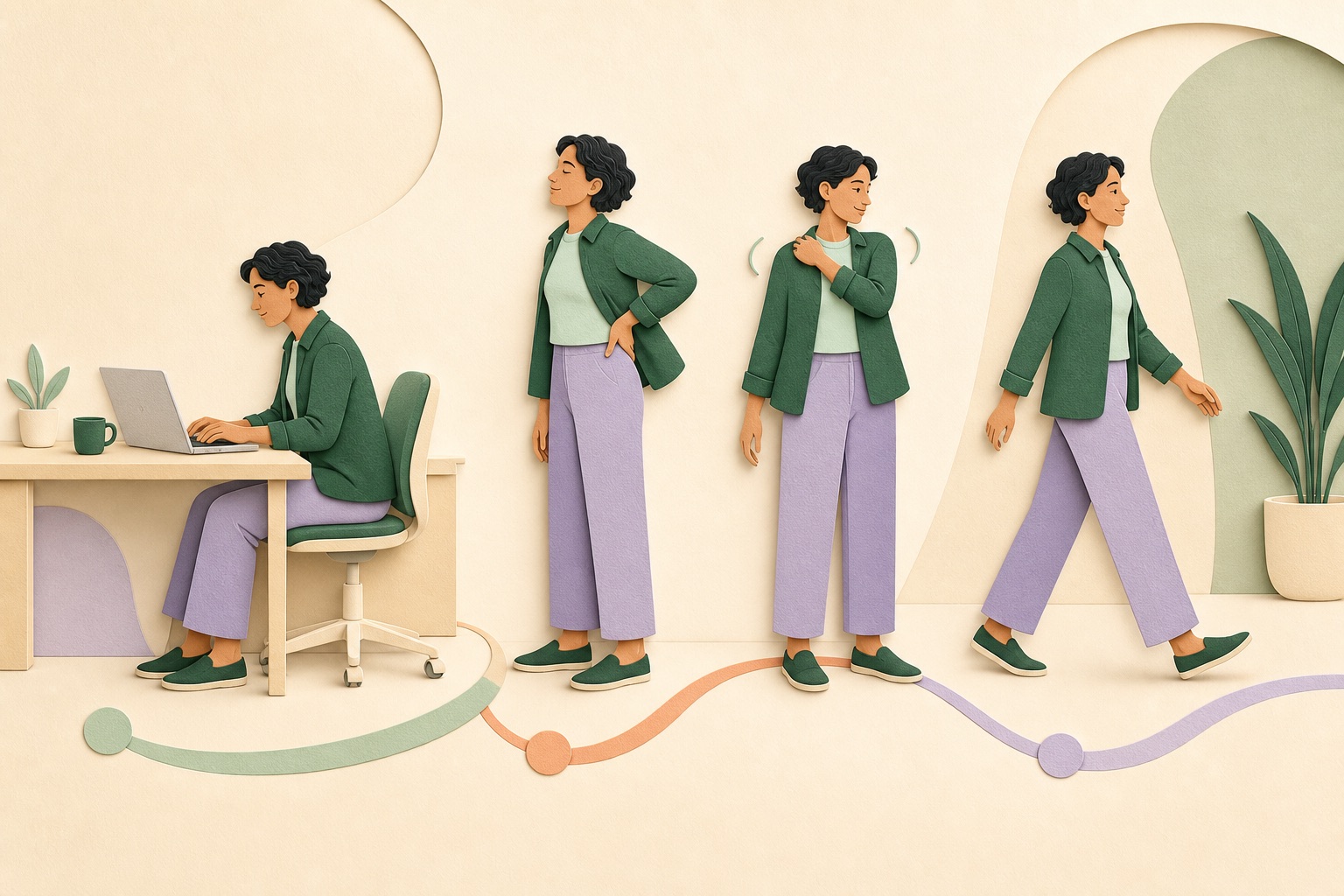
By the time your neck asks loudly for a break, the easy version of the break has often passed. You are deep into the task, the shoulders are braced, and standing up feels like an interruption rather than part of the work.
Posture breaks work best earlier and smaller. They do not need to be workouts. A change in backrest pressure, a look across the room, a standing phone call or a short walk can redistribute demand before one position owns the entire afternoon.
This is why “sit perfectly” is a weak strategy. Even a well-supported pose becomes tiring when held long enough. Movement gives tissues and attention a different job.
Key takeaways
- There is no single research-proven break interval for every worker and task.
- The benefit comes from changing exposure: muscle activity, joint position, visual focus and attention all get a chance to vary.
- In one six-month cluster-randomized trial, both active breaks and postural shifts reduced new-onset neck pain among high-risk office workers.
- Breaks should be attached to real task boundaries so they survive busy days.
- A posture cue is useful when it leads to choice and movement; it is counterproductive when it demands constant correction.
Why does a “good” posture still become uncomfortable?
Every posture distributes load somewhere. Sit upright and the trunk and neck muscles may do more active holding. Recline and the chair carries more load while hip and gaze angles change. Stand and the legs work differently. None of these arrangements is inherently best for an entire day.
Low-level static work has a particular character. The force is not dramatic, but the same muscle fibers may remain active while attention suppresses the urge to shift. Blood flow, local metabolites, sensory input and motor strategies change over time. The first sign may be restlessness rather than pain: you roll a shoulder, move closer to the screen or support the chin with a hand.
Those movements are not proof of bad posture. They are the body negotiating load.
An ergonomic home base can reduce unnecessary effort. It cannot eliminate the need to move. In fact, the better setup is often the one that permits several comfortable positions rather than holding you in one display-ready arrangement.
What is a posture break?
A posture break is any deliberate or spontaneous change that interrupts a sustained exposure. The name can be misleading because you do not always have to stop working.
There are at least four useful scales:
| Scale | Example | What changes |
|---|---|---|
| Micro-shift | Lean back, release the mouse, uncross legs | Pressure and muscle recruitment |
| Visual reset | Look across the room, close the eyes briefly | Focal distance and head orientation |
| Postural change | Move from sitting to standing or to another seat angle | Whole-body load distribution |
| Active break | Walk, refill water, perform comfortable movements | Circulation, attention and multiple joints |
The smallest changes are easy to overlook because they do not feel like exercise. That is their advantage. You can perform dozens without breaking concentration.
A break can also be cognitive. Ending one task and beginning another often changes gaze, hands and posture naturally. Good work design uses those transitions instead of adding a separate stream of alarms.
What does research say about break schedules?
The evidence does not identify one perfect formula. A Cochrane review compared different work-break schedules for preventing musculoskeletal symptoms in healthy workers. The included studies varied in break frequency, duration, work type and outcomes, and the certainty of evidence was low (Luger et al., 2019).
That means claims such as “everyone must move exactly every 30 minutes” exceed the evidence. It does not mean breaks are useless. It means the effective dose depends on context and that better trials are needed.
A separate systematic review and meta-analysis of microbreaks found small improvements in well-being, including vigor and fatigue, without an overall performance penalty. Performance effects varied by task and break duration (Albulescu et al., 2022). The review was broader than neck pain, but it addresses a common fear: taking a short break does not necessarily sabotage productive work.
The most directly relevant neck-pain trial is encouraging. Waongenngarm and colleagues enrolled office workers considered at high risk of developing neck or low-back pain. Over six months, participants received either an active-break intervention, a postural-shift intervention or a control condition. New-onset neck pain occurred in 17% of each intervention group and 44% of controls (Waongenngarm et al., 2021).
One trial cannot settle the schedule for everyone. It does suggest that small active breaks and even changes in sitting posture can be meaningful, especially for people accumulating long office exposures.
Is movement more important than perfect posture?
For everyday desk and phone work, that is often the more productive emphasis. Position still matters: a screen on the floor asks more of the neck than a readable screen placed in front of you. But a visually “perfect” posture held rigidly is not the end goal.
Movement changes several things at once:
- Which muscles are active and how strongly.
- Which joint positions are sustained.
- Where pressure falls on the chair and feet.
- What distance the eyes focus at.
- How much attention is locked to one task.
- Whether you feel capable of moving or afraid of leaving neutral.
The last point deserves attention. Some people respond to posture advice by bracing. They retract the chin hard, pull the shoulders down and monitor every drift. The resulting co-contraction can feel more tiring than the original slouch.
Try treating posture as a range around a home base. You can move through the range, use the chair, lean toward a task, then return or choose something else. A break expands the range; a correction narrows it.
How often should you move?
Use symptoms, task demands and feasibility rather than a universal timer.
If a task is highly static—editing on a laptop, reading fine print, detailed design—shorter bouts may feel better. If the task naturally includes walking, reaching and conversation, the same clock time contains more variation. A person with current symptoms may need earlier changes than a pain-free person doing familiar work.
A practical rhythm has three layers:
Continuous permission
Move whenever the body asks. Do not postpone a harmless shift because a timer has not fired. Restlessness is useful information.
Task-linked transitions
Attach a change to events that already happen: finishing a call, sending a document, running a build, completing a paragraph, switching patients or joining a meeting. These cues require less memory than a new routine.
Periodic active breaks
Add brief walks or comfortable movements during longer blocks. The exact interval can be tested. If you repeatedly dismiss a 20-minute alarm, it is not functioning as a cue. Choose a slightly longer interval plus stronger task boundaries, or redesign the work so movement is built in.
The measure of success is not the number of breaks logged. It is whether long static bouts become less dominant and work remains sustainable.
What should you do during a posture break?
There is no compulsory sequence. Choose movements that feel comfortable and contrast with the task.
After prolonged screen work, you might:
- Let the arms fall away from the keyboard.
- Look toward a distant object and allow the head to follow gently.
- Stand and take several ordinary steps.
- Turn the trunk and head comfortably to each side without forcing range.
- Reach the arms in a direction they have not used recently.
- Breathe normally and return when the task feels less sticky.
None of those actions has to “correct” a structure. They simply change input.
If stretching helps, use a mild, comfortable sensation rather than pulling the head hard. If strength work is part of a program, schedule it as exercise rather than squeezing a fatiguing set into every reminder. Our article on exercises for tech neck explains why a gradual program is different from constant corrective movement.
How do you remember without notification fatigue?
The first week of a reminder system is easy. The cue is novel, so you respond. Then attention learns that the notification is non-urgent. You dismiss it without reading, or you perform a theatrical one-second correction and return to the same task.
Reduce cue volume by making each cue more meaningful.
Detect duration, not every departure
Brief head movement is normal. A cue should wait for sustained drift rather than reacting whenever you glance down. This keeps the system aligned with the exposure you actually want to change.
Define one small response
Decide what the cue invites: release the shoulders, return gently toward a comfortable baseline, stand, or check whether the screen needs moving. A vague warning creates friction.
Allow intentional exceptions
You may be reading a document, drawing or looking down on purpose. Ignoring or pausing a reminder should be easy. A habit tool must respect the task.
End sessions
All-day monitoring turns awareness into background surveillance. Use cues during work blocks where sustained drift is likely. Stop when the session ends.
Our deeper review of whether posture reminders work covers short-term biofeedback evidence and the gap between immediate correction and lasting habit change.
How can a manager make breaks realistic?
Individual advice fails when work design punishes movement. A worker cannot take useful breaks if every pause is treated as disengagement or if meetings occupy the day without transition.
Teams can reduce friction by:
- Ending 60-minute meetings at 50 or 55 minutes.
- Making cameras optional when a walk-and-listen format works.
- Allowing people to stand or change position without explanation.
- Avoiding back-to-back scheduling as the default.
- Placing shared resources—water, printers, whiteboards—where brief walking is natural.
- Treating workload and staffing as ergonomic factors, not separate wellness topics.
Psychosocial workplace factors such as high demands, low control and low support have been associated with musculoskeletal symptoms in systematic reviews (Ariëns et al., 2001). A movement policy cannot compensate for impossible workload, but it can stop adding a cultural barrier.
What about deep work?
Some people worry that any break destroys concentration. The answer is not to pepper deep work with loud alerts. Use quieter layers.
Before starting, arrange the desk so the first position is low effort. Choose a work block with a clear endpoint. During the block, allow micro-shifts without leaving the task. At the endpoint, take a genuine active break before deciding whether to begin another block.
Audio can help vary posture without abandoning content. Listen to a paper or meeting while standing. Move reading from a laptop to a supported tablet. Use dictation for a first draft. These are task changes, not productivity losses.
The aim is to protect both kinds of attention: attention to the work and enough background awareness to notice when the body has been doing one thing for too long.
A one-week movement experiment
Do not redesign your life on day one. Test a narrow routine.
Day 1: Observe
Notice which tasks produce the longest static bouts. Do not correct them yet. Write down only the task and approximate time.
Day 2: Add one task boundary
Choose a repeatable event—finishing a call, sending a pull request, completing a study section—and stand or walk briefly after it.
Day 3: Prepare an alternate position
Raise the laptop with books and add an external keyboard, clear a standing surface, or make one reclined reading position usable.
Day 4: Add a quiet sustained-drift cue
Use one reminder during the highest-risk work block. Give it a clear response, then end the session when the block ends.
Day 5: Adjust the interval
If the cue arrived after discomfort, shorten the delay or use a stronger task boundary. If it interrupted normal movement, lengthen it.
Day 6: Keep only what helped
Remove the cue or setup change that created friction. Habits survive because they are useful, not because they are comprehensive.
Day 7: Review function
Ask whether work felt easier, long bouts decreased and recovery improved. Do not grade the week by a posture percentage.
When breaks are not enough
Ordinary stiffness that changes with movement is different from progressive or severe symptoms. Seek prompt medical assessment for symptoms after major injury, new weakness or numbness, loss of coordination, fever with significant neck stiffness, fainting or a sudden unusual severe headache.
If pain persists, repeatedly interrupts sleep or work, or makes normal movement increasingly difficult, consult a qualified healthcare professional. Breaks are one exposure-management tool, not a diagnosis or complete treatment plan.
Where Neckly fits
Neckly can support the quiet part of the routine: noticing that the head has stayed away from a calibrated position while attention is elsewhere. During an active session, supported headphone motion is compared with your baseline. A sustained forward, backward, left or right tilt can trigger a gentle cue.
The cue does not mean “your posture is wrong.” It means the current head position has lasted. You decide what happens next: return gently, lean back, raise the work, stand, walk, or ignore the cue because the position is intentional.
That is the habit Neckly is built for—not perfect posture, but earlier awareness and an easier next move.
References
- Luger T, et al. Work-break schedules for preventing musculoskeletal symptoms and disorders in healthy workers. Cochrane Database of Systematic Reviews. 2019. doi:10.1002/14651858.CD012886.pub2
- Albulescu P, et al. “Give me a break!” A systematic review and meta-analysis on the efficacy of micro-breaks for increasing well-being and performance. PLOS ONE. 2022;17(8):e0272460. doi:10.1371/journal.pone.0272460
- Waongenngarm P, et al. Effects of an active break and postural shift intervention on preventing neck and low-back pain among high-risk office workers: a 3-arm cluster-randomized controlled trial. Scandinavian Journal of Work, Environment & Health. 2021;47(4):306–317. doi:10.5271/sjweh.3949
- Ariëns GA, et al. Psychosocial risk factors for neck pain: a systematic review. American Journal of Industrial Medicine. 2001;39(2):180–193. doi:10.1002/1097-0274(200102)39:2<180::AID-AJIM1005>3.0.CO;2-#
Notice sustained head tilt—without a camera.
Neckly uses supported headphone motion during active iPhone sessions. It supports awareness; it does not diagnose pain or assess whole-body posture.
Download Neckly on the App Store