Habit design
Do Posture Reminders Work? What Biofeedback Can—and Cannot—Do
Posture reminders can improve awareness in the moment, but cue timing and fatigue matter. Learn what biofeedback evidence suggests for lasting habits.
By Neckly Editorial Team · Evidence reviewed 2026-08-29
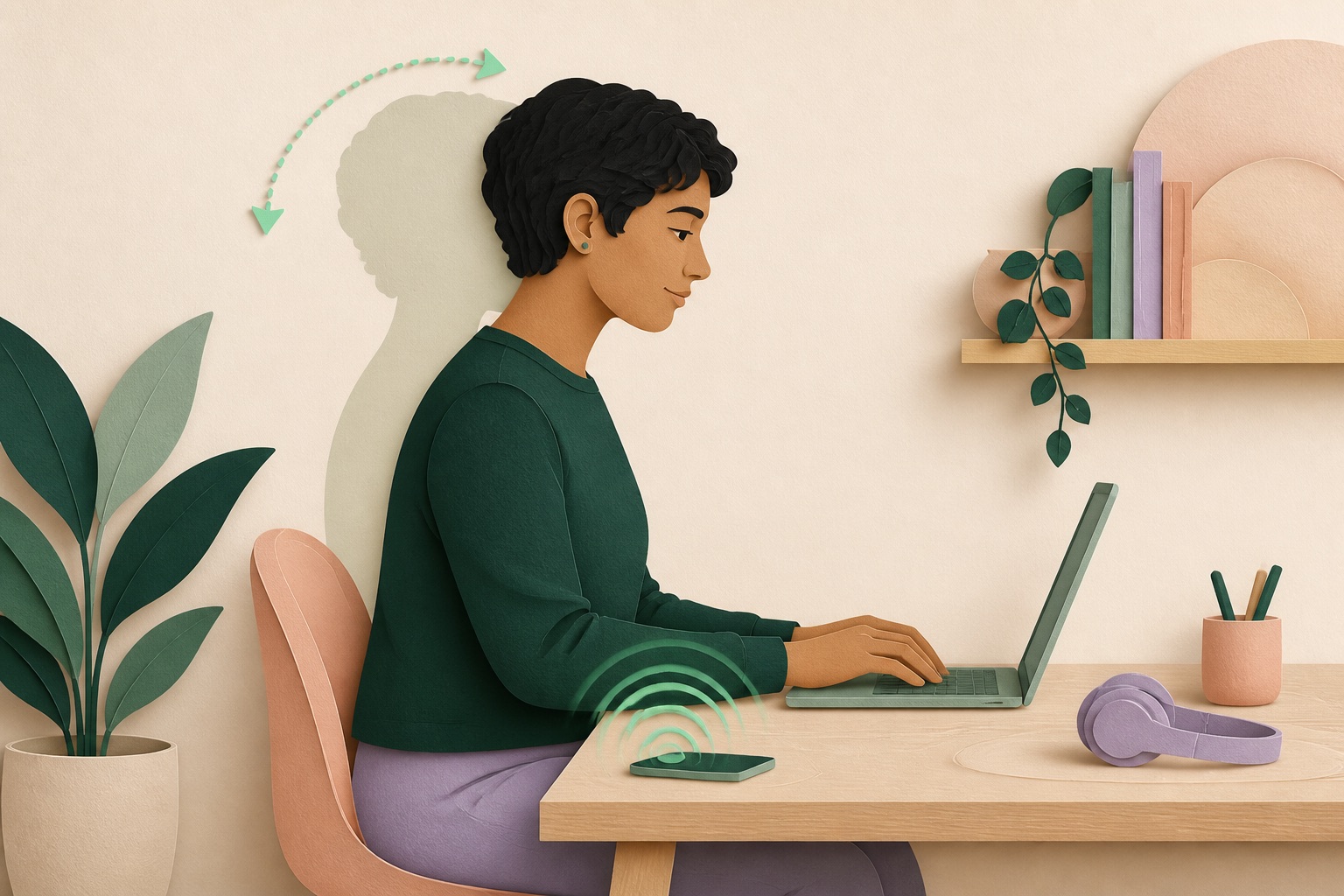
A posture reminder has one unfair advantage over good intentions: it can arrive while you are still absorbed in the task. That is also its greatest risk. Arrive at the wrong time, too often or with the wrong message, and the reminder becomes another thing to dismiss—or another reason to tense up.
Biofeedback does not “fix posture” for you. It measures something, turns that measurement into a cue, and gives you a chance to respond. The useful question is whether that loop improves awareness and behavior without creating alarm fatigue, dependence or fear of normal movement.
Research on wearable posture feedback is promising in the short term and still limited in the long term. Immediate changes in angle are easier to show than a durable habit, less pain or better function months later.
Key takeaways
- Biofeedback makes an otherwise hidden signal noticeable; it does not diagnose the cause of pain.
- Wearable and vibrotactile systems can change posture during a measured task, but short laboratory effects do not guarantee lasting habits.
- Too many alerts reduce attention and can encourage rigid self-monitoring.
- Better reminders wait for sustained exposure, use neutral language and allow intentional movement.
- A useful outcome is an easier choice—reset, move, adjust the task or take a break—not a perfect posture score.
What is posture biofeedback?
Biofeedback begins with sensing. A device measures a variable such as orientation, muscle activity, pressure or movement. Software compares that signal with a threshold or pattern. When the condition is met, the system returns information through vibration, sound, a visual display or another channel.
The loop looks simple:
- Measure: detect head, trunk or muscle behavior.
- Interpret: decide whether the pattern is meaningful.
- Cue: communicate at an appropriate moment.
- Respond: the user chooses an action.
- Learn: repeated useful responses may become easier over time.
Every step can fail. A sensor may drift. A threshold may react to normal movement. A vibration may arrive during a conversation. The user may correct for one second and return. The measured angle may improve while discomfort does not.
That is why a posture device should be judged as a behavior system, not only as a sensor.
What can wearable feedback change immediately?
Controlled studies suggest feedback can alter measured posture during a task.
In a 2025 laboratory study, Tuken and colleagues tested a wearable sensor-based vibrotactile system during typing. The system measured posture while surface electromyography recorded shoulder-region muscle activity. Haptic feedback affected postural behavior without a clear cognitive-performance penalty under the tested conditions (Tuken et al., 2025). The sample was small and healthy, and an acute typing experiment cannot show long-term pain prevention.
This distinction between feasibility and effectiveness matters. A device can prove that it detects a threshold and makes someone sit differently. That is not yet proof that users feel better, keep the change, or want to wear the device in real life.
Wearable systems are increasingly used to assess work-related musculoskeletal exposure. A 2024 systematic review mapped more than a hundred studies using wearable sensors across work tasks and highlighted the technology’s potential along with gaps in sectors, methods and real-world application (Motta et al., 2024). Measurement is advancing faster than consensus about what feedback should prescribe.
Does biofeedback reduce neck pain?
The evidence is emerging rather than settled.
A 2026 randomized controlled trial by Szeto and colleagues compared muscle biofeedback, posture biofeedback and home stretching in smartphone users with chronic neck pain. Both biofeedback groups used their devices for two hours daily over six weeks. Pain and Neck Disability Index scores improved within the biofeedback groups, while the control group did not show the same changes; posture and muscle-activity outcomes varied between groups (Szeto et al., 2026).
The trial is directly relevant and encouraging. It also does not make all posture reminders equivalent. The participants had chronic neck pain, the intervention lasted six weeks, and the devices targeted specific posture or muscle signals. Product algorithms, cue timing and adherence can differ substantially.
More broadly, a 2025 systematic review of biofeedback in chronic pain rehabilitation described possible benefits across physiological self-regulation and pain outcomes but emphasized heterogeneity in conditions, modalities and methods (Calderone et al., 2025). “Biofeedback” is a family of interventions, not one treatment.
The responsible summary is: feedback can help some people change behavior and may support symptom improvement, but the long-term effect of a particular consumer reminder must be demonstrated rather than assumed.
Why is short-term correction easier than habit change?
A vibration is hard to ignore the first day. Novelty makes the loop strong. The user moves, the sensor sees the change, and the demo looks convincing.
Habit formation asks more:
- Does the cue remain noticeable after hundreds of repetitions?
- Does the user understand what action to take?
- Is that action feasible during real work?
- Does the environment support the new behavior?
- Does learning transfer when the device is absent?
- Does the behavior improve comfort or function?
A person may become skilled at responding to a buzz without becoming better at noticing their own early fatigue. This is called dependence on external feedback. In motor learning, continuous feedback can improve performance during practice while sometimes weakening retention if the learner never has to use internal cues.
That does not mean feedback should be rare from the beginning. It means the system may need to evolve: clear feedback during learning, then less frequent or more selective cues as awareness improves.
What is alert fatigue?
Alert fatigue occurs when repeated cues lose meaning. Attention learns that the signal can be ignored. In healthcare, alarm fatigue is a serious safety problem; in consumer wellness, it is usually less dangerous but equally destructive to the habit.
Posture systems create fatigue when they:
- React to every small departure from an angle.
- Treat normal looking down as an error.
- Repeat without allowing the task to finish.
- Use identical urgency for mild drift and long exposure.
- Continue all day without a clear session boundary.
- Offer no way to explain intentional movement.
The user begins to swipe automatically, disable notifications or perform a brief theatrical reset. The measurement may show compliance for seconds while the underlying task remains unchanged.
A quieter system sends fewer, more defensible cues.
What should trigger a posture reminder?
For everyday head-posture awareness, duration is often the missing ingredient. Angle alone is too sensitive because normal life includes reading, tying shoes, cooking, drawing and looking around.
A useful trigger considers:
| Signal question | Why it matters |
|---|---|
| Has the head moved beyond a personal range? | People and setups differ. |
| Has the departure been sustained? | Brief movement is normal. |
| Is the motion stream reliable? | Missing or stale data should not become posture time. |
| Is the user in an active session? | Context gives the cue a purpose. |
| Was a cue just delivered? | Recovery and cooldown prevent nagging. |
| Is the movement intentional? | Pause and ignore controls preserve agency. |
This still does not identify “bad posture.” It identifies a sustained pattern relative to a chosen baseline.
Should the reminder tell you to sit up straight?
Usually not. “Sit up straight” is vague, moralized and biased toward appearance. It can lead to hard chin tucking, shoulder depression and breath holding.
Better cue language describes the event and keeps the response open:
- “Your head has stayed forward for a while.”
- “Ready for another position?”
- “Return gently, move, or adjust your setup.”
The cue should invite a small experiment. If returning toward the baseline feels better, useful. If the screen is too low, move it. If you have been still, stand. If the task requires looking down, ignore the cue or pause the session.
Agency is not a decorative feature. It prevents the device from turning ordinary movement into a threat.
Can posture reminders make pain worse?
They can be unhelpful for some people, especially when they increase worry or hypervigilance.
Pain is influenced by attention and threat. Someone already frightened that their neck is fragile may interpret each vibration as evidence of damage. They may stiffen, monitor constantly and avoid normal flexion. A well-intended cue becomes an alarm.
Stop or reduce reminders if you notice:
- More bracing or anxiety after cues.
- Constant checking of angles or scores.
- Avoidance of normal head movement.
- Noisy alerts disrupting concentration or sleep.
- Increasing symptoms despite a reasonable setup.
The response is not to push through a wellness tool. Turn it off, simplify the plan and seek professional guidance when pain or fear is persistent.
Our article Does poor posture cause neck pain? explains why posture information should not be presented as a damage forecast.
How should feedback fade over time?
There is no universal schedule, but the principle is simple: use enough feedback to learn, then leave room for self-noticing.
You can fade by:
- Running shorter sessions only during high-risk tasks.
- Increasing the sustained-duration threshold when awareness improves.
- Turning off repeat cues within a work block.
- Using summary trends rather than real-time correction every day.
- Practicing some sessions without feedback and comparing experience.
The target is not device independence at any cost. Some people value a quiet external cue indefinitely, just as they use a calendar. The question is whether the tool continues to add information.
What outcomes are worth tracking?
A posture percentage is easy to calculate and easy to overvalue. More time near a baseline might reflect useful awareness—or rigid stillness.
Track outcomes that connect to life:
- Are long unnoticed bouts less common?
- Do you respond earlier, before discomfort dominates?
- Is work easier to sustain?
- Are reminders becoming less frequent or more actionable?
- Do you move more freely rather than less?
- Can you identify setup problems faster?
- Are symptoms, function or confidence improving across weeks?
Treat trends as questions, not grades. A difficult project may produce more cues because the exposure changed. That observation can lead to a better monitor position or work rhythm; it should not become a verdict on discipline.
A humane reminder protocol
Try this during one recurring work block:
Calibrate a comfortable home base
Choose a supported, natural position. Do not force the chin or shoulders. The baseline is personal and session-specific.
Wait for sustained drift
Set or choose a system that ignores brief movement. The point is to catch absorption, not to eliminate flexion.
Use one neutral cue
Sound, haptic or visual feedback should be noticeable but calm. Avoid stacking channels unless one is insufficient.
Make one choice
Return gently, change position, move the task, stand or pause. No compulsory exercise circuit.
End the session
Stop monitoring when the work block ends. Review patterns later if useful.
Adjust from experience
If cues arrive too early, lengthen the threshold. If they arrive only after discomfort, shorten it or improve the workstation. If they create worry, stop.
This is a behavior experiment, not treatment.
Where Neckly fits
Neckly follows this narrow model. It uses the real motion stream from supported headphones during an active iPhone session. You calibrate a natural reference. Neckly watches for sustained forward, backward, left or right head tilt and can provide a gentle sound, haptic or visual cue.
It also has important limits. Neckly measures head orientation relative to the session baseline. It cannot see shoulders, spine, chair or whole-body alignment. It cannot determine why you moved or whether pain is present. Motion interruptions should not be counted as reliable posture time.
The product is designed to support awareness, not continuous correction. Read how an AirPods posture reminder works for the motion and privacy boundaries.
When a reminder is not the answer
Seek medical assessment for severe symptoms after injury, new weakness or numbness, coordination changes, fainting, fever with significant neck stiffness or a sudden unusual severe headache. Arrange a professional evaluation when pain persists, spreads, repeatedly interrupts sleep or work, or causes increasing fear of movement.
Biofeedback can provide information. It cannot perform a neurological examination, diagnose a headache or replace individualized care.
References
- Tuken D, Silva I, Vitali RV. Assessing vibrotactile feedback effects on posture, muscle recruitment, and cognitive performance. Sensors. 2025;25(8):2416. doi:10.3390/s25082416
- Motta F, et al. The use of wearable systems for assessing work-related risks related to the musculoskeletal system—a systematic review. International Journal of Environmental Research and Public Health. 2024;21(12):1567. doi:10.3390/ijerph21121567
- Szeto GPY, et al. The effects of muscle biofeedback versus posture biofeedback on pain and functional outcome in smartphone users with chronic neck pain. Applied Psychophysiology and Biofeedback. 2026. doi:10.1007/s10484-026-09799-1
- Calderone A, et al. The impact of biofeedback in enhancing chronic pain rehabilitation: a systematic review of mechanisms and outcomes. Heliyon. 2025;11:e41917. doi:10.1016/j.heliyon.2025.e41917
Notice sustained head tilt—without a camera.
Neckly uses supported headphone motion during active iPhone sessions. It supports awareness; it does not diagnose pain or assess whole-body posture.
Download Neckly on the App Store