Headache guide
Neck Pain and Headaches: When the Neck Is Part of the Picture
Neck pain and headaches often overlap, but not every headache comes from posture. Understand cervicogenic headache, tension-type headache and red flags.
By Neckly Editorial Team · Evidence reviewed 2026-08-29
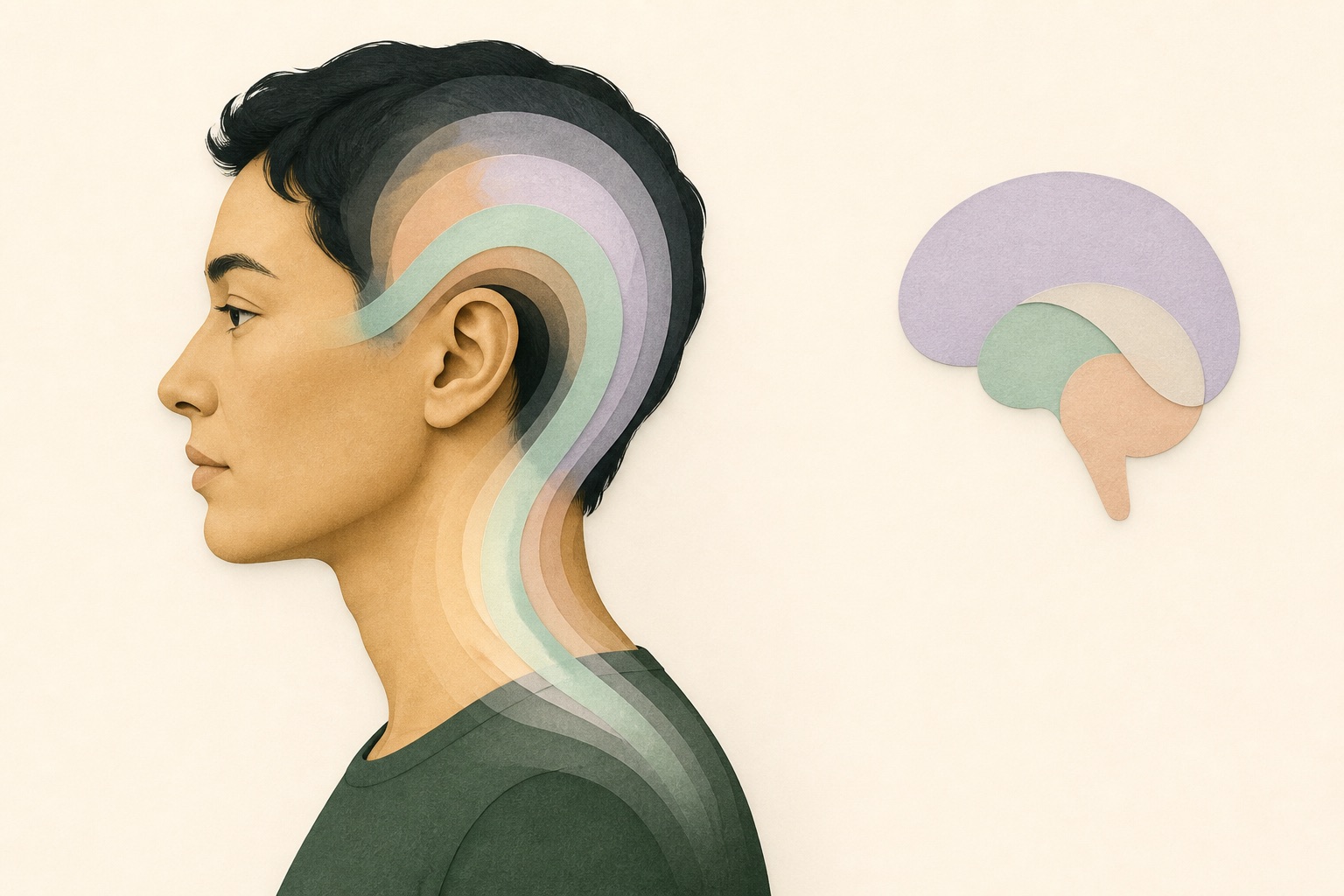
When a headache arrives after a long day at a screen, posture is an easy suspect. Sometimes the neck is part of the headache. Sometimes the neck hurts because a headache has already changed movement and sensitivity. Sometimes both symptoms share another driver—stress, sleep loss, illness or a primary headache disorder.
That overlap is why “sit straighter” is not a diagnosis.
The useful goal is to recognize patterns without collapsing every headache into tech neck. Cervicogenic headache is a recognized secondary headache attributed to a neck disorder, but it has specific diagnostic expectations. Tension-type headache and migraine can also include neck pain. A forward head position, by itself, cannot tell them apart.
Key takeaways
- Neck pain is common during headache, but co-occurrence does not prove that posture caused the headache.
- Cervicogenic headache refers to pain attributed to a disorder or lesion in the cervical region, with evidence of causation—not merely a stiff neck.
- Tension-type headache and migraine can both involve neck symptoms.
- A posture photograph cannot diagnose a headache type.
- New, sudden, severe or neurologically unusual headaches need medical assessment rather than self-treatment with posture changes.
How can the neck refer pain into the head?
Sensory information from upper cervical structures and from parts of the head converges in the trigeminocervical region of the nervous system. Because these inputs share processing pathways, pain arising from upper cervical joints, muscles or related tissues can be perceived in the head.
This referred-pain mechanism is biologically plausible and supported by clinical and experimental evidence. Bogduk and Govind’s review describes how pain from upper cervical structures can be referred to the head and explains why controlled diagnostic blocks are used in research and specialist diagnosis (Bogduk & Govind, 2009).
The mechanism does not mean every tight neck muscle is generating a headache. Convergence creates a possible pathway, not a shortcut to diagnosis. Headache disorders have overlapping symptoms, and people often change neck movement when any headache makes activity unpleasant.
What is a cervicogenic headache?
The International Classification of Headache Disorders, third edition, defines cervicogenic headache as a headache caused by a disorder of the cervical spine and its bone, disc or soft-tissue components, usually but not always accompanied by neck pain (ICHD-3).
Diagnosis requires more than location. There should be clinical or imaging evidence of a relevant cervical disorder and evidence that the headache is causally connected—for example, the headache developed with the neck disorder, improves as it improves, is provoked by specific neck maneuvers with reduced range, or is abolished by diagnostic blockade of a cervical structure or nerve supply.
Imaging alone is not decisive because findings such as age-related changes are common in people without headache. Likewise, tenderness or limited movement can appear in several headache conditions.
Features that may raise suspicion include pain beginning in the neck and moving toward the head, headache provoked by neck movement or sustained position, reduced cervical movement, and side-locked symptoms. None is perfectly specific. A clinician must consider the complete history and examination.
Is tension-type headache caused by posture?
Tension-type headache is often described as pressure or tightness, typically on both sides, with mild to moderate intensity and without the strong activity aggravation common in migraine. The word “tension” has encouraged a simplistic story in which tense muscles and posture are the whole cause. The disorder is more complex.
People with chronic tension-type headache may show differences in neck posture or mobility as a group. In a blinded controlled study, Fernández-de-las-Peñas and colleagues found more forward head posture and less cervical mobility among 25 people with chronic tension-type headache than among 25 controls. Within the headache group, posture angle correlated with headache frequency, but the authors explicitly called for further research on whether posture has a causal or maintaining role (Fernández-de-las-Peñas et al., 2006).
This is a classic association problem. A chronic headache may change how someone holds and moves the head. Reduced movement and a forward position may contribute to symptoms. Both may reflect sensitivity, stress or work exposure. A small cross-sectional study cannot choose one path.
Posture changes may still be worth trying if a particular desk or phone position reliably provokes symptoms. Judge the experiment by function and symptom response, not by the promise that straightening the neck will cure the headache disorder.
Can migraine include neck pain?
Yes. Neck pain and stiffness are common around migraine attacks. They may appear before, during or after the headache and can be part of the migraine symptom complex rather than evidence that the neck caused the attack.
Migraine often includes moderate to severe headache, sensitivity to light or sound, nausea, and aggravation by routine activity, but presentations vary. Some attacks have aura; many do not. A person who assumes every attack begins with posture may miss the pattern of a primary headache disorder and delay effective care.
The distinction matters because management differs. Moving the screen and taking breaks may reduce one trigger or improve comfort, but migraine may require a broader plan involving diagnosis, acute treatment, prevention and trigger management. Frequent or disabling headaches deserve medical evaluation.
Why does screen work trigger headaches even when the neck is not the source?
Screens combine several exposures:
- Sustained visual focus and reduced blink rate.
- Glare, contrast or brightness mismatch.
- Small text and uncorrected visual needs.
- Long periods of static head and arm position.
- Cognitive load and time pressure.
- Missed meals, dehydration or delayed sleep.
- Reduced movement and outdoor light.
A headache after screen work can emerge from more than one of these. Raising the monitor may help because it lowers neck demand; increasing text size may help because it lowers visual demand; ending a late session may help because it protects sleep.
Do not force a single explanation when several simple changes can be tested safely.
How can you track a useful pattern?
Keep a short headache record for several weeks if attacks recur. Avoid collecting so much data that tracking becomes another stressor.
Record:
- Start time and approximate duration.
- Where the pain began and where it spread.
- Quality and intensity in ordinary words.
- Associated symptoms such as nausea, light sensitivity, sound sensitivity, visual change, numbness or weakness.
- Neck movement or position that clearly worsened or eased it.
- Sleep, meals, illness, medication and menstrual context when relevant.
- What you took or changed and what happened next.
This information is more clinically useful than a single side-view posture photo. It helps reveal whether headache follows a recurring screen block, occurs on waking, clusters with sleep disruption or has features suggestive of migraine or another condition.
What low-risk changes can help during screen work?
These changes manage exposure; they do not diagnose or treat a specific headache disorder.
Make the screen easy to see
Increase text size and reduce glare. Place the main monitor directly in front of you. If you wear progressive lenses, test a screen height that does not force the chin up. Consider a vision assessment if you repeatedly move close to otherwise readable content.
Vary focal distance
Look away from the screen periodically, ideally toward something farther away. This also gives the head a reason to leave its fixed orientation.
Support the task
Bring keyboard and mouse close, rest the forearms and raise frequently read documents. For long phone use, support the elbows and bring the device higher rather than holding it in the lap.
Move without forcing
Stand, walk or turn the head through a comfortable range. Avoid aggressive self-manipulation or pulling on a painful neck in an attempt to “release” a headache.
Protect ordinary needs
Eat, drink and sleep on a reasonable schedule. These suggestions sound unglamorous because they are not branded interventions. They are also frequent casualties of long screen sessions.
See desk work and neck pain and posture breaks for detailed setup and movement strategies.
Does exercise help cervicogenic headache?
Exercise may help some people, particularly when it is matched to a clinical diagnosis and individual findings.
A randomized controlled trial by Jull and colleagues compared manipulative therapy, a specific low-load exercise program, a combination, and control care in people with cervicogenic headache. At seven weeks and 12 months, manipulative therapy and the exercise intervention reduced headache frequency and intensity, with some combined effects (Jull et al., 2002).
The trial does not mean a generic internet stretch treats every headache. Participants met diagnostic criteria and received a structured intervention. Exercise for chronic nonspecific neck pain also has broader supportive evidence, but headache type matters.
If neck movement clearly provokes recurrent headaches, a clinician or physical therapist can assess mobility, strength, endurance and neurological signs. A plan may include gradual movement and exercise rather than passive treatment alone. Our guide to exercises for tech neck explains the general evidence while keeping diagnosis separate.
Which headache signs need urgent care?
Most headaches are not emergencies, but certain patterns should not be managed as posture problems.
Seek urgent medical help for:
- A sudden, extremely severe headache that reaches peak intensity quickly.
- Headache after a significant head or neck injury.
- New weakness, numbness, facial droop, confusion, fainting, seizure, trouble speaking, new severe balance problems or loss of vision.
- Fever with marked neck stiffness, rash or significant illness.
- A new severe headache during pregnancy or after delivery.
- A new or changing headache in someone with cancer, immune suppression or a serious systemic condition.
- A headache pattern that is rapidly worsening or very different from prior attacks.
This list is not exhaustive. If something feels acutely wrong, seek care. Do not wait for a posture change or app cue to settle it.
Arrange a non-urgent assessment for frequent headaches, increasing medication use, attacks that disrupt normal life, or uncertainty about the type. A clear diagnosis often creates more useful options than endless trigger hunting.
Can posture reminders prevent headaches?
There is not enough evidence to claim that a posture reminder prevents headache disorders. A cue may help if sustained head position is one reliable aggravating factor. It may also prompt a visual break, walk or screen adjustment that lowers overall demand.
But reminders can backfire when they encourage constant symptom monitoring. Someone with frequent headache may already be highly attentive to the neck. Repeated alerts can add threat and make ordinary movement feel unsafe.
Use a cue narrowly:
- Only during tasks where sustained drift is common.
- After a meaningful duration rather than every movement.
- With neutral language.
- With permission to ignore or end the session.
- As one part of a headache plan, not a substitute for diagnosis.
The guide Do posture reminders work? explores this trade-off in more detail.
Where Neckly fits—and where it stops
Neckly uses motion from supported headphones during an active session. It compares current head orientation with a position you calibrate and can cue sustained forward, backward, left or right tilt.
That can be useful when a long screen task reliably includes unnoticed head drift. The cue might lead you to reset gently, look away, move the work or take a break.
Neckly cannot identify cervicogenic headache, migraine or tension-type headache. It cannot detect neurological red flags, see your cervical structures or determine why your head hurts. It is a wellness awareness tool, not a headache monitor or medical device.
Treat the cue as a small piece of context. If headache is recurrent, unusual or disabling, the next useful signal should come from a qualified healthcare professional.
References
- Headache Classification Committee of the International Headache Society. 11.2.1 Cervicogenic headache. International Classification of Headache Disorders, 3rd edition. ICHD-3 diagnostic criteria
- Bogduk N, Govind J. Cervicogenic headache: an assessment of the evidence on clinical diagnosis, invasive tests, and treatment. The Lancet Neurology. 2009;8(10):959–968. doi:10.1016/S1474-4422(09)70209-1
- Fernández-de-las-Peñas C, et al. Forward head posture and neck mobility in chronic tension-type headache: a blinded, controlled study. Cephalalgia. 2006;26(3):314–319. doi:10.1111/j.1468-2982.2005.01042.x
- Jull G, et al. A randomized controlled trial of exercise and manipulative therapy for cervicogenic headache. Spine. 2002;27(17):1835–1843. doi:10.1097/00007632-200209010-00004
Notice sustained head tilt—without a camera.
Neckly uses supported headphone motion during active iPhone sessions. It supports awareness; it does not diagnose pain or assess whole-body posture.
Download Neckly on the App Store